Ontario Real Estate Daily: Rates, Transit, Schools, HST Relief, and the Streets Between the Listings
By Avi Samaroo and Quan Ve ·
Ontario real estate is changing in layers: steadier rates, shifting GTA supply, new-home HST relief, transit expansion, school construction, and community amenities. Today’s YorkNine Daily explains what buyers, sellers, investors, and future movers should watch now.
Ontario real estate is no longer one simple market. It is a collection of micro-markets where one street can feel competitive, another can feel patient, and a future transit stop, school investment, daycare space, or main-street amenity can quietly change how a community lives. Today’s YorkNine Daily connects the signals that matter most for buyers, sellers, investors, and future movers across Ontario: rates, affordability, inventory, new-home tax relief, supply, transit, schools, child care, and neighbourhood energy.
Today’s Signal · Why It Matters · YorkNine Interpretation
Bank of Canada rate hold · Borrowing costs are more predictable, but still demanding. · Plan carefully instead of waiting for perfect rates. GTA sales up, listings down · Some pockets can tighten even while prices remain softer. · Study neighbourhood inventory, not only headlines. New-home HST relief · Eligible buyers may see meaningful help on qualifying new homes. · Compare the rebate against total closing costs and resale value. Transit, schools, and amenities · Daily-life infrastructure can shape long-term desirability. · Follow the services people use every day.
1. The Rate Hold Is a Planning Window, Not a Victory Lap

The Bank of Canada held its target overnight rate at 2.25% on April 29, 2026, with the Bank Rate at 2.5% and the deposit rate at 2.20%. For Ontario households, that creates a clearer planning window, but it does not erase affordability pressure or renewal risk.[1] A rate hold should be treated as a moment to calculate properly, not a signal to overextend.
Buyers should stress-test payments at today’s rate, a slightly higher rate, and a future renewal scenario. Sellers should remember that buyers are making decisions through the lens of monthly payment comfort. Investors should model rental income, vacancy, maintenance, insurance, taxes, and financing without relying on appreciation to rescue weak numbers.
YorkNine Takeaway: The rate hold creates breathing room. It does not create a shortcut.
2. The GTA Is Tightening in Some Places While Prices Still Feel Soft
TRREB reported 5,946 GTA home sales in April 2026, up 7.0% from April 2025, while new listings fell 9.3% to 17,097. At the same time, the MLS Home Price Index composite benchmark was down 6.6% year over year and the average selling price fell 4.9% to $1,051,969.[2] That is the definition of a split market.
A market can have softer prices and still become competitive in specific pockets. A renovated semi near transit, a family townhouse near schools, a rural property with lifestyle appeal, and an investor condo are not moving under the same conditions. The right question is not, “How is Ontario doing?” The better question is, “How is this exact property type behaving in this exact community?”
Detail to Watch · Why It Matters
Active comparable listings · Shows real choice for buyers. Sold comparables in the last 30–60 days · Shows current demand. Days on market · Reveals whether sellers are adjusting. Condition and layout · Explains why two similar homes can sell differently.
YorkNine Takeaway: Ontario real estate is now a microscope market. The neighbourhood number matters more than the average number.
3. Affordability Is Improving, But It Is Not Solved

RBC reported that Canadian housing affordability improved for an eighth consecutive quarter in Q4 2025, but also warned that gains are becoming weaker and more uneven. In Toronto, ownership costs for an average home were still estimated at 62.9% of a typical household’s income.[6] That is an improvement from the peak, but it is not relief for every household.
For buyers, this means lower prices may open doors, but the monthly cost must still work after mortgage payments, property tax, utilities, maintenance, insurance, condo fees, and lifestyle costs. Some families may find better value by adjusting geography, choosing a townhouse instead of detached, considering income potential, or moving toward communities where schools and transit are improving.
For sellers, affordability pressure means presentation matters. A home that feels move-in ready, functional, and low-friction can stand out because buyers are already stretched and want fewer surprises after closing.
YorkNine Takeaway: Affordability is becoming less impossible, but it is still demanding. Preparation and flexibility matter.
4. New Homes Have a Major HST Story — But Math Still Comes First

Ontario introduced legislation on May 5, 2026 to support HST relief on eligible new homes in partnership with the federal government. The province stated that relief could provide buyers of most new homes in Ontario with up to $130,000 in relief, including full 13% relief on eligible new homes valued at $1 million or less.[7]
This is important for pre-construction and new-build buyers, but it should not be treated as a universal buy signal. The right question is whether the purchase still works after builder pricing, deposit structure, development charges, closing adjustments, occupancy fees, assignment restrictions, completion timing, mortgage qualification, and resale alternatives.
New-Build Question · Why It Matters
What is the true all-in closing cost? · Tax relief may not offset every adjustment. Can relief be assigned to the builder? · It can affect upfront price and financing. What happens if completion is delayed? · Approval, rent plans, and sale timing can change. How does resale compare today? · Existing homes may already reflect softer pricing.
YorkNine Takeaway: HST relief can improve the new-home equation, but serious buyers still need the full math.
5. Supply Is Being Built Unevenly — Watch the Product Type

CMHC reported that the six-month trend in housing starts fell 2.9% in March 2026 to 248,378 units, while actual starts in centres with populations of 10,000 or more were up 10% year over year. CMHC also noted stronger year-to-date starts in Ontario and higher multi-unit activity in Toronto.[3]
This matters because supply is not one thing. A city may add multi-unit housing while still having limited detached homes. A growing town may approve housing faster than schools, roads, transit, and child care can catch up. A neighbourhood may show cranes in the sky but still offer little product for families needing three bedrooms, parking, outdoor space, and a practical commute.
Buyers should evaluate future supply by product type. Sellers should understand whether their property competes against new inventory or stands apart from it. Investors should watch whether future completions will strengthen rental demand or increase competing supply.
YorkNine Takeaway: Do not ask only whether homes are being built. Ask what kind, where, at what price, and for whom.
6. The Condo and Investor Playbook Needs Discipline

CREA’s spring 2026 housing outlook described a market still being shaped by affordability, supply, rate expectations, and regional variation.[4] BMO also noted that Canadian housing conditions remain uneven, with sales and price behaviour differing by region and product type.[5] For Ontario investors, that means the old playbook of buying anything and waiting is not enough.
A disciplined investor should model conservative rent, realistic expenses, vacancy, repairs, insurance, property tax, condo fees, financing, and the possibility of slower resale. In the condo market, the details matter: maintenance fees, reserve fund health, building reputation, exposure to future supply, transit access, tenant profile, and whether the unit has a layout people actually want to live in.
The strongest investor opportunities are often not the loudest ones. They are the properties where the numbers are honest, the holding period is realistic, and the community has durable demand from renters, commuters, students, healthcare workers, families, or downsizers.
YorkNine Takeaway: In 2026, investors should buy discipline, not hype.
7. Oakville’s Transit-Oriented Growth Shows How Communities Are Changing

Ontario’s 2026 zoning order for a transit-oriented community in Oakville points to the kind of mixed-use growth that can reshape how people evaluate a location.[8] Buyers do not only purchase a property. They purchase the daily rhythm around it: how quickly they can reach transit, whether they can walk to coffee, where children can go after school, how groceries fit into the commute, and whether the community feels alive outside the house.
For Oakville, the story is not just prestige or waterfront appeal. It is increasingly about how transit, mixed-use development, retail, restaurants, public space, and family services can work together. This is the type of local signal that buyers and investors should track across Ontario, from established GTA suburbs to fast-growing communities beyond the core.
YorkNine Takeaway: The best communities are not only built with homes. They are built with daily life in mind.
8. Clarington and the East GTA Remind Us That Construction Can Be Opportunity
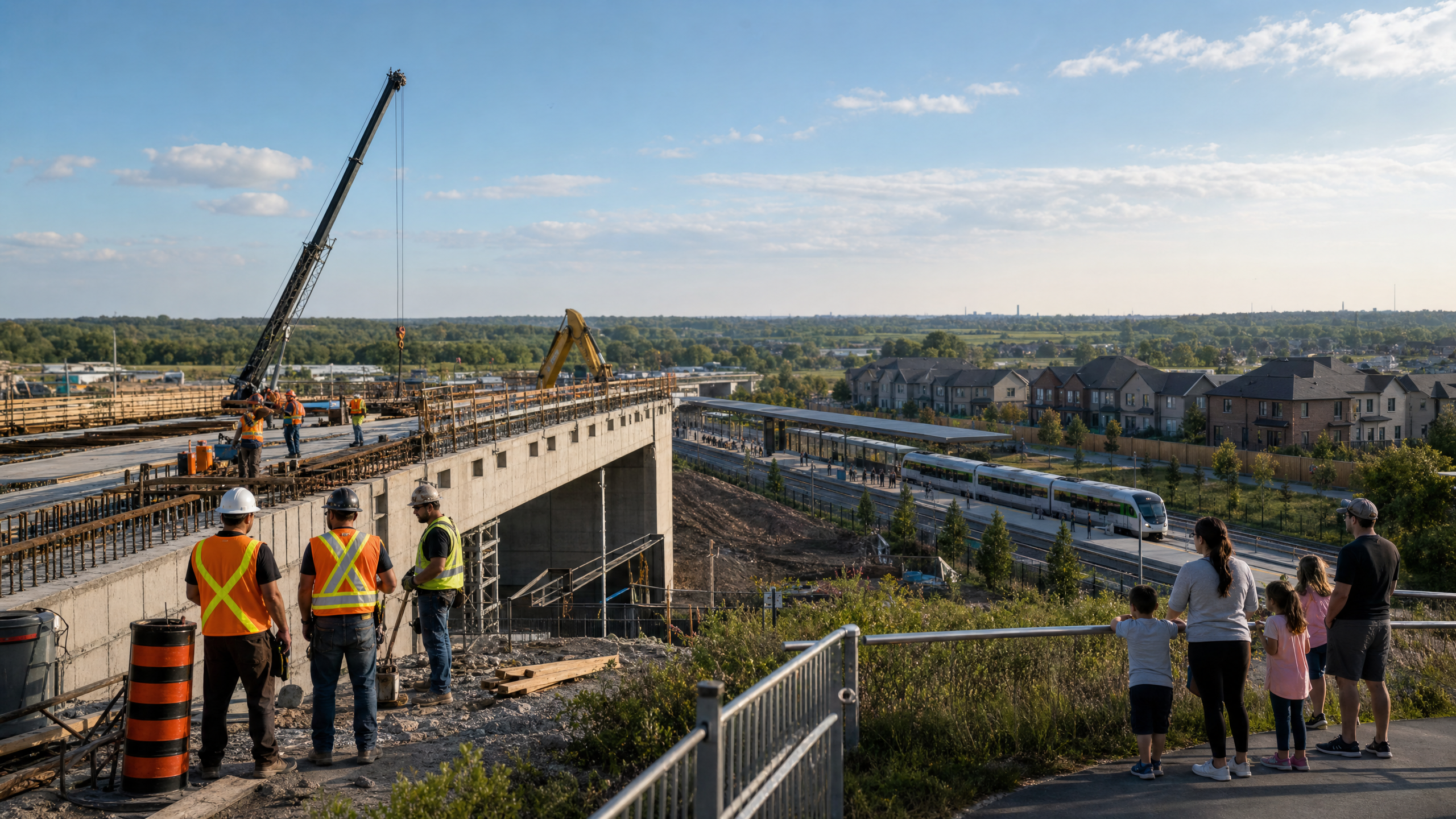
Clarington’s official update on GO Train bridge construction is a reminder that infrastructure often looks inconvenient before it becomes valuable.[9] For people living near construction today, road closures, noise, detours, and uncertainty can feel frustrating. For long-term buyers and investors, those same projects may signal future accessibility, commuter appeal, and stronger connection to the broader GTA.
This is where timing matters. A buyer who understands future transit before the market fully prices it in may identify value earlier. A seller near a future station may need to tell the right story about access, growth, and long-term convenience. Investors should still be cautious, because transit alone does not guarantee returns, but it can strengthen the demand profile when paired with schools, services, employment access, and reasonable pricing.
YorkNine Takeaway: Infrastructure is a story in two chapters: disruption first, convenience later.
9. Schools, Child Care, Restaurants, and Main Streets Are Real Estate Data Too

Ontario announced $1.6 billion to build and expand schools across the province, supporting more than 27,000 new student spaces and more than 1,600 new licensed child-care spaces.[10] That is not just education policy. It is real estate intelligence, because families often make housing decisions around school capacity, commute patterns, child-care access, and the services that make daily life workable.
Lifestyle signals matter too. Restaurant groups expanding across Ontario, new retail openings, entertainment venues, community centres, parks, and daycare announcements can all change how a neighbourhood feels to someone considering a move.[11] These details may look small beside interest rates and price charts, but they often explain why one area becomes loved while another remains merely affordable.
For buyers, these signals help answer, “Can I build a life here?” For sellers, they help tell a stronger neighbourhood story. For investors, they indicate whether demand is supported by real human behaviour, not just spreadsheet assumptions.
YorkNine Takeaway: Great real estate content must study the street, not only the sale price.
Final Word From YorkNine
The Ontario market is rewarding people who read deeper. Rates matter, but so do schools. Prices matter, but so does product type. HST relief matters, but only when the math works. Transit matters, but only when it connects to a complete community. The smartest decisions in 2026 will come from combining financial discipline with local intelligence.
For buyers, this is a season to prepare hard and negotiate wisely. For sellers, it is a season to price with evidence and present with purpose. For investors, it is a season to respect the numbers. For future movers, it is a season to watch communities before everyone else starts talking about them.
Authored by Avi Samaroo and Quan Ve for the YorkNine Journal.
Verified Sources
[1]: Bank of Canada, April 29, 2026 policy-rate announcement. [2]: TRREB, April 2026 GTA market update. [3]: CMHC, March 2026 housing-starts release. [4]: CREA, Spring 2026 housing market outlook. [5]: BMO Economics, Canadian housing monitor. [6]: RBC Economics, housing affordability report. [7]: Ontario Newsroom, HST relief legislation for new homes. [8]: Ontario zoning order for Oakville transit-oriented community lands. [9]: Municipality of Clarington, GO Train bridge construction update. [10]: Ontario Newsroom, $1.6 billion school and child-care construction announcement. [11]: Retail Insider, Ontario restaurant expansion coverage.
Related articles
- GTA Market Update and Bank of Canada Interest Rate News for September 8 2026
- GTA Real Estate Market Update for September 7 2026
- Ontario Real Estate Market Update for September 6 2026
- YorkNine Journal Market Briefing September 5 2026
- YorkNine Journal Market Briefing for September 4 2026
- YorkNine Journal Market Update for September 3 2026